
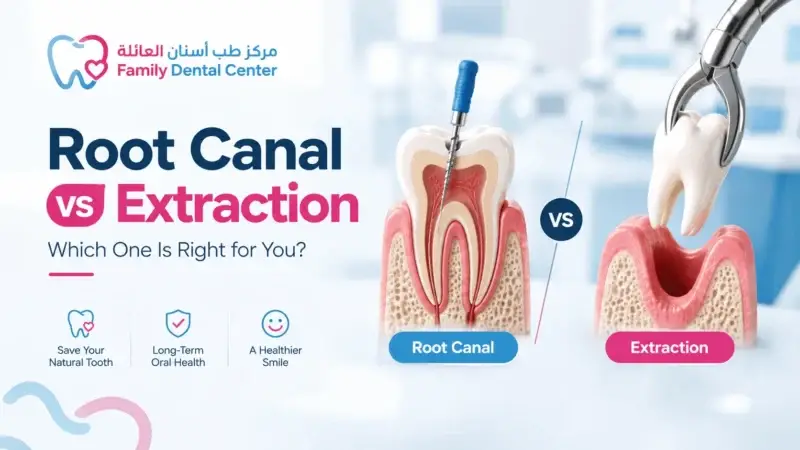
When a tooth is badly decayed, cracked or infected, the choice usually comes down to root canal vs extraction. You can keep the tooth and treat it from the inside, or remove it and plan a replacement. Neither is automatically right. The better option depends on how much sound tooth remains, the health of the surrounding bone and gum, your medical history and your plans after an extraction. This guide explains when each treatment makes sense and how the two compare on cost, pain, time and long-term results. It also covers the decisions patients most often regret.
When a tooth can be saved with a root canal
A tooth can usually be saved when the problem sits inside the pulp and the tooth still has enough healthy structure, root length and bone support to hold a filling or crown.
Root canal treatment (endodontic therapy) removes the inflamed or infected pulp, disinfects the canals and seals them with a rubber-based material called gutta-percha. It suits:
- Irreversible pulpitis: lingering pain after hot or cold drinks, or pain that wakes you at night.
- A periapical abscess: infection at the root tip, sometimes with swelling or a small gum boil, where the root itself is intact.
- Deep decay that has reached the nerve but left solid tooth walls.
- Trauma that has killed the pulp, common in front teeth after falls or sports injuries.
Signs the tooth is a good candidate
Dentists look for four things:
- enough tooth above the gum for a crown to grip (known as a ferrule)
- a tooth that feels firm rather than loose
- healthy gum attachment
- no crack running into the root
Take a lower molar with a large old filling, pain on biting and a dark area at the root tip on the X-ray, but with solid walls and firm gums. That tooth has a strong prognosis with a root canal followed by a crown.
Cracked teeth: where the line falls
A cracked tooth can often be saved if the crack stays in the crown of the tooth. It usually cannot be saved once the crack runs into the root. Dentists separate three situations:
- Craze lines are harmless surface lines in the enamel.
- A cracked tooth has a crack starting at the biting surface. It often causes sharp pain when you release a bite, and a crown, sometimes with a root canal, can hold it together.
- A split tooth has divided into separate pieces and almost always needs removal.
Cracks are the hardest cases to judge, because fine cracks rarely show on standard X-rays. Your dentist will rely on bite tests and magnification, and sometimes on what they see once the tooth is opened.
When extraction is the better choice
Extraction makes sense when the tooth cannot be restored predictably, however well the canals are cleaned.
- Vertical root fracture: a crack running down the root cannot be sealed, and the tooth will keep getting reinfected.
- Too little tooth left: decay extending deep below the gum line leaves nothing for a crown to hold.
- Advanced periodontal disease: if bone loss has left the tooth loose, a root canal treats the inside but cannot rebuild the support around it.
- Repeated failure: a tooth that still shows infection after retreatment or surgery may have reached its limit.
- Wisdom teeth: a third molar that is hard to reach, partly erupted or not used for chewing is rarely worth saving.
If one of these applies, the discussion moves on to how you will replace the tooth.
Back molars and second molars
Molars take most of your chewing force. They also have three or four canals, which are sometimes curved or narrowed, so treatment is more complex and costs more than for a front tooth. First and second molars are usually worth saving when they can be restored. Losing one shifts chewing load onto the teeth nearby and lets the opposing molar drift into the gap.
A second molar at the very back is a genuine judgement call. If it has no opposing tooth to bite against and would be difficult to restore, removing it without replacement can be reasonable. If it is in active use, saving it is normally the better investment.
Medical factors that change the balance
Your health history can push the decision either way. Some patients have taken bisphosphonates or similar bone-strengthening drugs, or have had radiotherapy to the head and neck. For them, extraction carries a risk that the jawbone fails to heal (osteonecrosis of the jaw), so dentists lean strongly towards saving the tooth. Poorly controlled diabetes slows healing after either procedure.
Mention every medication you take. That includes osteoporosis injections given once or twice a year, which patients often forget.
Root canal vs extraction: cost, time and long-term results
Extraction is cheaper and quicker on the day. Once you add a replacement tooth, though, a root canal with a crown usually costs less overall and stays closer to the natural result.
Many patients compare root canal vs extraction on the first invoice alone. A fair comparison looks at the complete path for each option.
| Factor | Root canal + crown | Extraction + implant | Extraction only |
|---|---|---|---|
| Upfront cost | Moderate | Low at first, high once the implant is added | Lowest |
| Total cost over time | Moderate | Highest | Low, but can rise if neighbouring teeth need work later |
| Number of visits | Usually 2 to 4 (root canal, then crown) | Often 4 or more (extraction, implant surgery, crown) | 1 |
| Time to a finished tooth | A few weeks | Usually 3 to 6 months, longer if a bone graft is needed | Immediate, but leaves a gap |
| Natural tooth and bone kept | Yes | Tooth lost; implant helps maintain bone | No; bone shrinks at the site |
| Main long-term risk | Reinfection, or fracture if left without a crown | Implant failure or peri-implantitis | Drifting teeth and bite changes |
What it costs in Oman
Prices at private clinics in Muscat vary widely. The ranges below are indicative only.
| Treatment | Indicative range (OMR) |
|---|---|
| Simple extraction | About 10 to 45 |
| Root canal, front tooth | About 55 to 120 |
| Root canal, molar | About 60 to 180 |
| Crown after a root canal | About 150 to 280 |
| Single dental implant | About 400 to 900 |
These ranges come from several published sources. One Muscat clinic lists root canals at OMR 60 to 100 for a single-canal tooth and OMR 100 to 180 for a molar, with a crown at OMR 150 to 280. On a clinic comparison site, molar root canal fees in Muscat run from about OMR 60 to 70 at one clinic to OMR 120 to 150 at another. Another Muscat provider quotes a single implant at roughly OMR 400 to 800 or more, depending on the clinic and the case. A price guide averaging 18 clinics in Oman puts implants at about USD 1,621 to 2,333 and extractions at USD 28 to 111, which converts to roughly OMR 625 to 900 and OMR 11 to 43.
On these figures, extraction followed by an implant often costs around twice as much as a root canal with a crown. The gap widens further if you need a bone graft.
When you collect quotes, ask what each one includes. A root canal quote should cover the core build-up and crown. An implant quote should state whether it includes the abutment and crown. Check your health insurance policy too, since plans often cover root canals and extractions but limit or exclude crowns and implants.
Root canal vs extraction: which hurts more?
After the procedure, a surgical extraction usually hurts more. During treatment, the two feel similar: dentists perform both under local anaesthesia, and most patients feel pressure rather than pain.
After a root canal, expect tenderness when biting for a few days. After an extraction, soreness and swelling usually peak within the first two to three days, and the socket takes one to two weeks to heal. Avoid smoking and drinking through straws during that time, since both raise the risk of dry socket (alveolar osteitis). Much of the pain people link to root canals actually comes from the infection beforehand.
Long-term results
Root-canal-treated teeth have a strong record. A 2010 systematic review in the International Endodontic Journal, by Ng, Mann and Gulabivala, pooled the published evidence. It found that between 86% and 93% of teeth were still in place 2 to 10 years after treatment.
The factor most strongly linked to survival was a crown placed after treatment. Teeth with neighbours on both sides also did better, as did teeth not supporting a bridge or denture and teeth other than molars.
Implants are a well-established alternative, but they need maintenance. Peri-implantitis, an infection of the gum and bone around an implant, is the main long-term threat. Smokers and people with a history of gum disease face the highest risk.
Replacement options after extraction at a glance
After an extraction you can replace the tooth with an implant, a bridge or a removable partial denture, or leave the gap. Each choice affects the neighbouring teeth and bone differently.
| Option | How it works | Effect on neighbouring teeth | Typical timeline | Best suited to |
|---|---|---|---|---|
| Dental implant | A titanium or zirconia post fuses with the jawbone (osseointegration) and carries a crown | Adjacent teeth are left untouched | 3 to 6 months, longer with grafting | Adults with enough healthy bone |
| Fixed bridge | A false tooth held by crowns on the teeth either side | Both neighbours must be reshaped | 2 to 3 weeks | Cases where the neighbours already need crowns |
| Resin-bonded (Maryland) bridge | A false tooth bonded to the back of the neighbouring teeth | Minimal drilling | A few weeks | Front teeth with light bite forces |
| Removable partial denture | A plate with artificial teeth that clips onto remaining teeth | Clasps add load and wear | A few weeks | Several missing teeth or a tight budget |
| No replacement | The gap is left open | Teeth may tilt and the opposing tooth may over-erupt | Not applicable | Some last molars at the end of the arch |
When you weigh root canal vs extraction, the replacement belongs in the price. If you plan an implant, ask about socket preservation, where the dentist places graft material in the socket at the time of extraction. The jaw ridge loses much of its width in the first months after a tooth comes out. Leaving the site for a year without a plan can mean a larger graft later.
Common mistakes when choosing extraction over treatment
The most common mistake is choosing extraction because it is cheaper today. Patients who do this often haven’t priced the replacement or considered how the gap will change their bite.
- Comparing only the first bill. The extraction fee is small; an implant or bridge to fill the space is not.
- Assuming severe pain means the tooth is lost. Intense pain usually comes from inflamed pulp, which a root canal removes. Pain level says little about whether the tooth can be saved.
- Leaving the gap “for now”. Neighbouring teeth drift and the opposing tooth can grow into the space. Both changes can make a later bridge or implant harder to place.
- Avoiding treatment because of old stories. With modern local anaesthesia, rotary instruments and rubber dam isolation, most patients find a root canal similar to a long filling appointment.
- Writing off a tooth because a previous root canal failed. Many failures come from a leaking filling or a missing crown. Retreatment or an apicoectomy (minor surgery at the root tip) can often still save the tooth.
- Deciding in the middle of an emergency. A dentist can relieve pain the same day by opening the tooth and removing the pulp. That gives you time to decide calmly with proper X-rays.
How your dentist helps you decide
Your dentist weighs root canal vs extraction using examination, imaging and your personal circumstances. A good dentist explains the prognosis of each option rather than simply naming one.
What the assessment includes
- X-rays, plus a CBCT (3D) scan when a crack, an extra canal or complex root anatomy is suspected
- Pulp tests with cold or a mild electric stimulus to check whether the nerve is alive
- Bite and tapping tests to help locate cracks
- Gum probing to measure pocket depth and check whether the tooth is loose
- A review of your medical history and current medications
When to see an endodontist
An endodontist is a dentist with specialist training in root canal treatment. A referral is worthwhile for curved or calcified canals, for retreating a failed root canal, and for borderline teeth that could reasonably go either way. Endodontists typically work with a dental operating microscope, which helps them find hidden canals and fine cracks.
Questions worth asking
- How would you rate this tooth’s prognosis: good, fair or poor?
- What is the full cost of each option, including the crown or replacement?
- If I choose extraction, which replacement do you recommend, and when?
- What is likely to happen if I wait?
Frequently Asked Questions
Is it better to pull a damaged tooth?
Usually not, if the tooth can be restored. A natural tooth with a good prognosis generally outperforms any replacement for chewing, sensation and bone preservation. Extraction is the better route when the tooth has a vertical root fracture, too little remaining structure or severe bone loss. When the prognosis is poor, removing the tooth and planning an implant can be the more reliable long-term choice.
Does a root canal guarantee the tooth lasts for life?
No. A root canal removes the infection but does not make the tooth indestructible. Treated teeth can still decay, crack or become reinfected if the seal leaks. Many last for decades with a good crown, regular check-ups and normal brushing and flossing.
What happens if I delay a root canal?
The infection keeps progressing. Pain may come and go, or stop once the nerve dies, while bacteria continue to destroy bone around the root tip. Waiting can turn a treatable tooth into one that needs extraction. Facial swelling with fever, or difficulty swallowing or opening your mouth, needs same-day care.
Does extracting a tooth affect the neighbouring teeth?
Yes, over time. Without the tooth, the teeth beside the gap tend to tilt towards it and the opposing tooth can over-erupt. This opens spaces where food gets trapped, changes your bite and raises the risk of decay and gum disease in those teeth. Planning a replacement soon after the extraction limits these changes.