
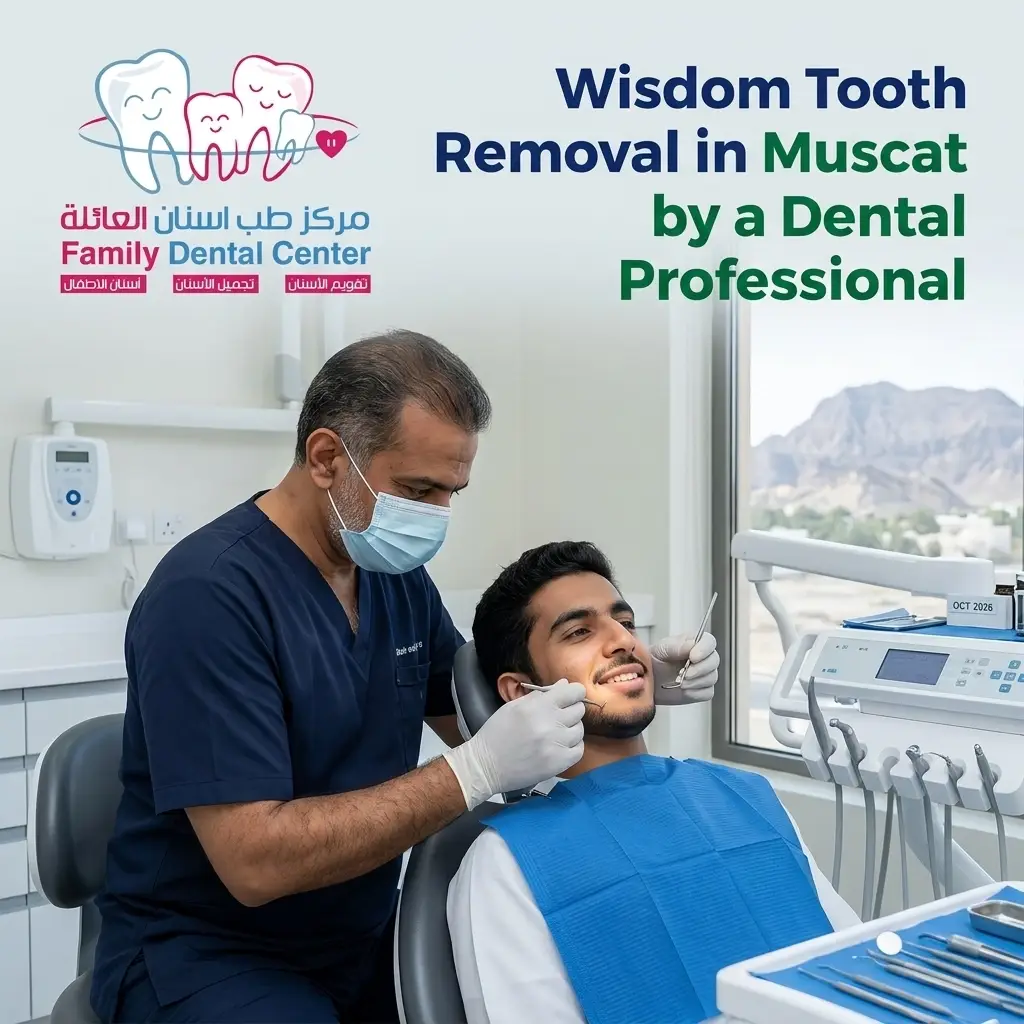
Published prices for wisdom tooth removal in Muscat run from about OMR 40 for a simple extraction to about OMR 180 for a fully impacted tooth. This guide explains when removal is justified, how the price breaks down, what happens in the chair, and how to recover without problems such as dry socket. It also covers when a general dentist is enough and when an oral and maxillofacial surgeon is the safer choice.
When Should a Wisdom Tooth Be Removed?
Not every wisdom tooth needs to come out. Dentists recommend extraction when a tooth causes a specific problem, or is clearly heading toward one, and an X-ray confirms it. Many patients seeking wisdom tooth removal in Muscat arrive after a painful gum infection, but the main reasons are:
- Impacted wisdom tooth: the tooth is trapped under the gum or bone, or tilted against the second molar.
- Recurring infection: food and bacteria collect under the flap of gum over a partly erupted tooth (pericoronitis).
- Decay: the tooth sits too far back to clean or fill reliably.
- Damage to the neighbouring tooth: pressure or decay spreads to the second molar.
- Cysts: a fluid-filled sac forms around an unerupted tooth, usually found on a panoramic X-ray.
A healthy wisdom tooth that sits in a clean, stable position can usually be monitored with regular check-ups instead of being removed.
Simple vs Surgical Removal: Which Costs Less and Why?
Simple removal costs less. It suits a fully erupted tooth that the dentist can grip. After local anaesthesia, the dentist loosens the tooth and lifts it out.
Wisdom tooth removal surgery is needed when the tooth is partly covered by gum or lies in bone. The surgeon opens the gum, removes a small amount of bone if necessary, and often cuts the tooth into sections so each piece comes out through a smaller opening. Stitches close the site.
Surgery costs more because it takes longer, needs a sterile surgical set, depends on imaging beforehand, and carries a more demanding recovery. Roots that curve around the lower jaw nerve or reach into the sinus add difficulty, and with it, cost.
Wisdom Tooth Removal in Muscat: How Much Does It Cost?
Expect roughly OMR 40 to 70 for a simple extraction, OMR 80 to 130 for a surgical extraction of a partly impacted tooth, and OMR 140 to 180 for a fully bony impacted tooth. These ranges reflect prices published by a Muscat dental clinic in 2026. Other clinics and hospitals set their own fees, so treat the figures as a benchmark, not a quote.
| Type of extraction | Typical situation | Published range (OMR) |
|---|---|---|
| Simple | Fully erupted, accessible tooth | 40 to 70 |
| Surgical | Partly impacted, needs minor bone removal or sectioning | 80 to 130 |
| Fully bony impacted | Often a horizontal lower tooth | 140 to 180 |
| Imaging (separate) | Panoramic X-ray or CBCT scan | 15 to 60 |
The wisdom tooth removal cost in Oman depends first on difficulty, which only an X-ray reveals. A clinic that gives you a single flat wisdom tooth extraction price over the phone, without seeing your image, is guessing.
What Else Affects the Price of Wisdom Tooth Removal?
Local Anaesthesia, Sedation, or General Anaesthesia
Local anaesthesia is the standard for most extractions. You stay awake, feel pressure but no pain, and go home straight away. Wisdom tooth removal under sedation adds a second layer, and the options differ in how deeply they affect you:
- Nitrous oxide: an inhaled gas that relaxes you and wears off within minutes.
- Oral sedation: a tablet taken before the visit, leaving you drowsy but responsive.
- Intravenous (IV) sedation: a drip that produces deep relaxation and little memory of the procedure.
- General anaesthesia: full unconsciousness, given by an anaesthetist, usually in a hospital theatre.
Each step up adds monitoring equipment and professional time, and the fee rises with it. After IV sedation or general anaesthesia, arrange for someone to drive you home.
Dental X-Rays and CBCT Scans
Imaging is the first line item in wisdom tooth removal in Muscat, because the surgeon cannot plan the extraction without it. A panoramic X-ray shows both jaws, all four wisdom teeth, and any cysts.
A cone-beam CT (CBCT) scan adds a three-dimensional view. Surgeons order it when the roots of an impacted wisdom tooth lie close to the lower jaw nerve or the sinus. Ask whether the quoted wisdom tooth removal price includes the scan.
Removing One Wisdom Tooth or All Four
Removing all four teeth in one session means one recovery period and one sedation fee. Patients booking wisdom tooth removal in Muscat for all four often choose IV sedation, because the appointment runs long. Upper wisdom teeth usually come out more easily than lower ones, so the lower pair drives most of the difficulty and cost.
Some surgeons treat one side at a time, which leaves you able to chew on the other side during the first week.
General Dentist or Oral and Maxillofacial Surgeon?
A general dentist can handle an erupted tooth with a clear X-ray and healthy surroundings. An oral and maxillofacial surgeon is the better choice for a fully bony impacted tooth, roots touching the nerve or sinus, a cyst, or any case that needs IV sedation or general anaesthesia. Medical conditions that complicate healing also point toward a surgeon.
The surgeon’s fee is higher, but a referral early in the process often costs less than a complicated extraction that has to be finished elsewhere.
How the Procedure Works, Step by Step
Wisdom tooth removal in Muscat is an outpatient procedure, so most patients leave the same day. A single extraction usually takes 15 to 40 minutes in the chair.
- Consultation and imaging: the clinician reviews your symptoms and medical history and takes an X-ray or CBCT scan.
- Choice of anaesthesia: you agree on local anaesthesia, sedation, or general anaesthesia based on how complex the tooth is and how anxious you feel.
- Numbing: the anaesthetic takes effect within a few minutes. Tell the clinician if you feel sharp pain.
- Extraction: the clinician loosens and removes the tooth, with gum incision, bone removal, or sectioning if it is impacted.
- Closing the site: the clinician cleans the socket, places dissolvable stitches when needed, and gives you gauze to bite on while a clot forms.
- Instructions: you receive written aftercare, prescriptions, and a follow-up date.
Recovery Timeline and Aftercare
Wisdom tooth removal recovery depends on how difficult the extraction was and how many teeth came out. Good wisdom tooth aftercare in the first three days matters more than anything you do later.
| Period | What to expect |
|---|---|
| Day 1 | Bleeding tapers over a few hours. Bite on gauze, rest, and eat only soft, cool food. |
| Days 2 to 3 | Swelling usually peaks around 48 hours. Use a cold pack externally, 20 minutes on and 20 off. |
| Days 4 to 7 | Pain and swelling ease. Warm salt-water rinses, gently, from about day 3. |
| Weeks 1 to 2 | Stitches dissolve and the gum closes over the site. Surgical cases take longer. |
Tips for Faster Wisdom Tooth Removal Recovery
The same rules apply to wisdom tooth removal in Muscat as anywhere: protect the blood clot, and keep the site clean without disturbing it.
- Skip straws, smoking, vaping, and forceful rinsing for at least the first 72 hours.
- Eat yoghurt, mashed potato, scrambled eggs, and lukewarm soup.
- Take pain relief exactly as your dentist prescribed.
- Avoid hard exercise until the swelling settles.
- Brush the other teeth normally and keep the toothbrush away from the socket.
- Attend the follow-up visit.
Complications to Watch For: Dry Socket and Infection
Serious problems after wisdom tooth removal in Muscat are uncommon, but three are worth knowing.
What Is Dry Socket?
Dry socket (alveolar osteitis) happens when the clot in the socket dislodges and exposes bone. The classic sign is pain that was improving and suddenly worsens around day 3 to 5, often spreading to the ear, with a foul taste. Smoking, straws, and vigorous rinsing are the usual triggers. One visit fixes it: the dentist cleans the socket and places a medicated dressing.
Signs of Infection After Wisdom Tooth Removal
Pus, fever, a persistent bad taste, and swelling that grows after day 3 point to infection. Antibiotics are prescribed when the dentist finds a clinical reason, not after every extraction. Swelling that spreads toward the neck, or any difficulty swallowing or breathing, is an emergency.
Numbness in the Lip or Tongue
Lower wisdom tooth roots can sit close to the nerve that supplies the lip, chin, and tongue. Numbness is usually temporary, but report anything lasting beyond 48 hours.
Does Insurance Cover Wisdom Tooth Removal?
Dental cover is often a separate benefit from medical cover, with its own annual limit and exclusions. Insurers tend to approve extraction of an impacted wisdom tooth more readily when an X-ray shows a medical reason, such as infection, decay, or a cyst, than when removal is preventive.
Before booking wisdom tooth removal in Muscat, ask your insurer these questions:
- Is simple extraction covered?
- Is surgical removal of an impacted tooth covered?
- Are X-rays or CBCT scans included?
- Is sedation or general anaesthesia covered?
- Does the plan require pre-authorisation, and is the clinic in the network?
Ask the clinic for an itemised treatment plan and your X-ray. Insurers usually need both.
Frequently Asked Questions
How Much Does Wisdom Tooth Removal Cost in Muscat?
Wisdom tooth removal in Muscat costs about OMR 40 to 70 for a simple extraction and up to about OMR 180 for a fully bony impacted tooth, based on one clinic’s published 2026 ranges. Imaging is billed separately at roughly OMR 15 to 60. Ask for a written, itemised estimate before treatment.
How Long Does Wisdom Tooth Removal Take?
Most single extractions take 15 to 40 minutes in the chair. Fully impacted lower teeth take longer, and removing all four in one session can take one to two hours, plus time for sedation to wear off.
Is Wisdom Tooth Removal Painful?
No pain is felt during the procedure once the anaesthetic works, only pressure and movement. Soreness, swelling, and jaw stiffness follow for several days and respond to the pain relief your dentist prescribes.
How Many Days Off Do I Need After Wisdom Tooth Removal?
Plan for one to two days after a simple extraction and three to five days after surgery, longer if you have all four teeth out or a physically demanding job. Swelling peaks at about 48 hours, so schedule the procedure before a quieter stretch of your week.
Can Several Wisdom Teeth Be Removed in One Visit?
Yes, up to all four. The lower pair is the deciding factor: if both are deeply impacted, many surgeons split the work into two visits, one side each, to keep recovery manageable.
Does Insurance Cover Wisdom Tooth Removal in Oman?
Sometimes. Coverage depends on your policy’s dental benefit, and impacted teeth with a documented medical reason are the most likely to be approved. Send your insurer the itemised plan and X-ray before booking.
Conclusion
Get the X-ray first, then a written estimate that lists imaging, anaesthesia, the extraction, and follow-up. With those in hand, wisdom tooth removal in Muscat becomes a straightforward comparison between clinics, and you will know whether your case belongs with a general dentist or a surgeon.