
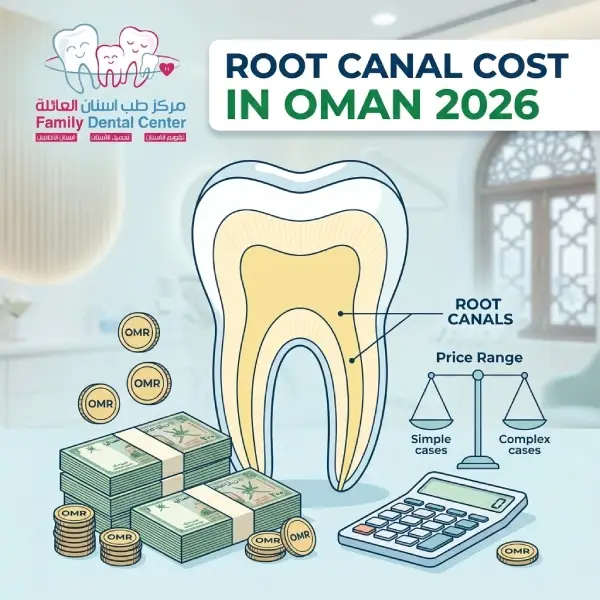
Root canal cost in Oman depends on the tooth treated, the number of canals, the complexity of the case, and the technology used. Molars generally cost more to treat than front teeth because they have more canals and take longer. A permanent filling or dental crown after treatment may be billed separately.
Root canal treatment removes infected or inflamed tissue from inside a tooth so the natural tooth can be kept. An examination is needed to confirm the treatment required and to give you a cost estimate in Omani Rial (OMR), but usually the cost ranges from 60 to 150 OMR.
Root canal cost in Oman by tooth type
The root canal cost in Oman depends partly on which tooth requires treatment, because the number and shape of the canals change how long the work takes.
Front teeth usually have a single, accessible canal, so treatment is generally the most straightforward. Premolars have one or two canals. Molars have three or four, often narrow, curved, or difficult to locate, which lengthens treatment and is why molar root canal cost is usually higher. Extensive decay, previous dental work, or infection can add procedures at any tooth.
| Tooth type | Treatment complexity | Main factors affecting cost |
|---|---|---|
| Front teeth | Usually less complex costs around 60 to 80 OMR | Number of canals, tooth condition, and extent of infection |
| Premolars | Moderate; varies by case costs around 80 to 100 OMR | Canal anatomy, number of canals, and treatment difficulty |
| Molars | Often more complex costs around 100 to 150 OMR | Multiple canals, curved roots, and longer treatment time |
There is no single root canal price in Oman that applies to every patient. The table compares treatment complexity rather than fixed prices.
What affects the final price of a root canal?
Several factors influence the final root canal treatment price in Oman:
- Tooth type and number of canals: Molars generally require more extensive treatment than front teeth because they usually contain more root canals.
- Severity of infection: A tooth with significant inflammation, an abscess, or infection around the root may require additional procedures depending on the clinical findings.
- Dentist’s experience: Fees may vary according to the dentist’s qualifications, experience, and expertise in treating complex root canal cases.
- Microscope-assisted treatment: A microscope root canal procedure uses magnification to help the dentist examine the inside of the tooth more closely. This technology can be particularly useful for locating narrow or calcified canals and identifying complex anatomy. Its availability and cost depend on the clinic and the treatment required.
- Retreatment: If a previous root canal has failed or infection persists, the dentist may recommend retreatment. This procedure can be more complicated than initial treatment and may increase the overall cost.
- Final restoration: After root canal treatment, the tooth may need a permanent filling or crown to restore its function and protect it from fracture. These costs may be separate from the root canal fee.
Before starting treatment, request a written estimate that explains the expected procedures and any additional charges, and confirm whether it includes X-rays, temporary and permanent fillings, and a crown if necessary.
Does insurance cover root canal treatment in Oman?
Some dental insurance plans in Oman cover root canal treatment, but coverage depends on your insurance provider, policy, and annual dental benefit limits. Other plans may apply exclusions, co-payments, or restrictions.
Before booking your appointment, contact your insurance provider to confirm whether endodontic treatment is covered. Ask whether you need pre-authorization and whether diagnostic X-rays, permanent fillings, and dental crowns are included.
It is also important to check whether your chosen dental clinic accepts your insurance plan and whether you must pay any portion of the treatment yourself.
If your policy does not cover the full root canal treatment cost in Oman, request a detailed treatment estimate from the clinic.
Does a root canal hurt? What to expect step by step
A root canal is not usually painful, because local anesthesia numbs the area during the procedure. The pain many patients feel beforehand is caused by inflammation or infection inside the tooth.
Although the exact process varies, root canal treatment usually involves the following steps:
- The dentist examines the tooth, reviews your symptoms, and takes dental X-rays when needed to assess the roots and surrounding tissues.
- Local anesthesia is administered to numb the affected area. The dentist then creates a small opening in the tooth to access the pulp and root canals.
- The infected or inflamed tissue is removed. The dentist cleans, shapes, and disinfects the root canals to reduce bacteria and prepare them for filling.
- The canals are sealed with a suitable filling material. Depending on the condition of the tooth, a temporary filling may be placed if additional treatment sessions are necessary.
- The tooth is restored with a permanent filling or dental crown, depending on how much healthy tooth structure remains.
Some tenderness or mild discomfort may occur after treatment. Severe or worsening pain, persistent swelling, or other unusual symptoms should be assessed by your dentist.
What is a root canal and when is it needed?
A root canal is a dental procedure used to treat infection or inflammation affecting the pulp inside a tooth. The pulp contains nerves and blood vessels. When it becomes damaged, root canal treatment can remove the affected tissue, clean the canals, and seal the tooth.
Deep tooth decay is a common reason for needing treatment. Cracks, dental trauma, and repeated dental procedures can also damage the pulp.
Common symptoms include persistent toothache, prolonged sensitivity to hot or cold temperatures, pain when biting, and swelling around the gums. In some cases, an abscess may develop near the affected tooth.
These symptoms do not automatically mean that you need a root canal. A dentist must evaluate your symptoms, examine the tooth, and use X-rays when appropriate to establish a diagnosis.
Early assessment can help prevent complications and may improve the chances of saving the natural tooth.
Success rate and how long a treated tooth lasts
Root canal treatment has a good success rate in many cases, although the outcome depends on the original condition of the tooth, the extent of the infection, the quality of the procedure, and the final restoration.
A successfully treated tooth can last for many years and may last a lifetime with appropriate care. However, no dentist can guarantee the same outcome or lifespan for every patient.
Avoid putting excessive pressure on a tooth that has only a temporary filling or has not yet received its recommended permanent restoration. If a crown is advised, follow your dentist’s instructions about when to have it placed, since delaying the permanent restoration can affect the outcome.
A tooth that has lost substantial structure may be more vulnerable to fracture. The dentist will recommend the most appropriate restoration based on the tooth’s location, remaining structure, and overall condition.
How to choose a dentist for a root canal in Muscat
When comparing root canal treatment cost in Muscat between clinics, consider the dentist’s qualifications, experience, diagnostic facilities, and approach to patient care rather than focusing on price alone.
Ask whether the dentist regularly performs root canal procedures and has experience managing complex cases. If your tooth has narrow or difficult-to-locate canals, you may also want to ask whether microscope-assisted treatment is available.
Before committing to treatment, request a clear explanation of the recommended procedure, the expected number of visits, and the total estimated cost.
Family Dental Centre can help you arrange a consultation to discuss your dental concerns and determine whether root canal treatment is appropriate for your condition.
Book a root canal consultation
If you have persistent tooth pain, sensitivity, or swelling around a tooth, arranging a dental assessment is an important first step. Delaying treatment may allow an infection to progress and could make the tooth more difficult to save.
During your consultation, the dentist can examine the affected tooth, explain the available treatment options, and provide an estimate based on your specific needs.
Contact Family Dental Centre to ask about appointment availability and root canal treatment options in Muscat. A professional assessment will help you understand the treatment process, expected costs, and any additional procedures that may be necessary.
Frequently asked questions
How much does a root canal cost in Muscat?
The root canal cost in Muscat varies according to the type of tooth, the number of canals, the severity of the infection, and the complexity of the procedure. The final bill may also include a permanent filling or dental crown, usually the cost ranges from 60 to 150 OMR. Ask for a breakdown of all expected charges in OMR.
Why do root canal prices differ between clinics?
Root canal prices differ because clinics may have different fee structures, equipment, treatment techniques, and levels of clinical expertise. Some quotes include additional procedures, while others cover only the root canal itself. Always compare the services included in each estimate.
Will I need a crown after a root canal?
Not every tooth requires a crown after root canal treatment. However, molars and teeth with substantial structural damage may benefit from a crown to reduce the risk of fracture and restore chewing function. Your dentist will assess the remaining tooth structure and recommend an appropriate restoration.
Is it cheaper to pull the tooth than to do a root canal?
Tooth extraction may initially cost less than root canal treatment followed by a permanent restoration. However, extracting a tooth can create additional costs if replacement is needed later. Options such as a dental implant or bridge may be recommended depending on your oral health. Your dentist can explain the advantages, disadvantages, and expected costs of each option.
How many visits does a root canal take?
Most root canals take one or two visits. A single visit is usually enough when the canals are straightforward and the infection is limited. Root canal sessions increase when there is an abscess or persistent infection, because medication may be placed in the canals between appointments, or when a molar has complex canals that take longer to clean.
Can I get a root canal on the same day?
Same-day root canal treatment may be possible if an appointment is available and the dentist determines that your condition is suitable. However, some cases require additional assessment or multiple visits. If you have severe pain or swelling, contact a dental clinic promptly to determine the appropriate next step.