
For many residents in the Sultanate of Oman, achieving a perfectly aligned smile often feels like a distant dream due to dental crowding. Beyond aesthetics, crowded teeth significantly impact oral health and gum hygiene. With the advancement of clear aligners crowded teeth oman, using invisalign for crowded teeth has become the most sought-after solution in Muscat, offering flexibility and stunning results without the need for metal wires. In this comprehensive guide, we will explore everything you need to know about treating crowding with clear aligners.
What Causes Crowded Teeth? (H2)
Dental crowding occurs when there is insufficient space in the jaw to accommodate all teeth in their natural positions, forcing them to grow at angles or overlap. While the result is always a lack of space, the reasons why this happens can vary significantly from one patient to another.
Understanding the root cause of your crowding is the first step toward a successful treatment plan, as it helps your orthodontist determine how much space needs to be reclaimed. Generally, these issues stem from three primary factors:
Genetics and Jaw Size (H3)
The most common cause of crowding is often written in your DNA. Genetics can lead to an inherited small jaw size that simply does not match the size of larger teeth. When the “foundation” is too narrow for the “occupants,” teeth have no choice but to twist or push against each other to fit.
Early Loss of Baby Teeth (H3)
Baby teeth act as essential placeholders for the adult teeth waiting beneath the surface. If a baby tooth is lost too early due to decay or injury, the surrounding teeth may drift into the vacant area. This leads to permanent teeth shifting into incorrect or cramped spaces as they emerge, creating a crowded environment.
Impacted Wisdom Teeth (H3)
As we reach late adolescence, the arrival of third molars, or wisdom teeth, can create a “domino effect” in the mouth. If there isn’t enough room in the back of the jaw, these impacted teeth can push against existing teeth. This constant pressure often causes teeth to bunch up or overlap at the front of the jaw, disrupting an once-straight smile.
Can Invisalign Fix Crowded Teeth? (H2)
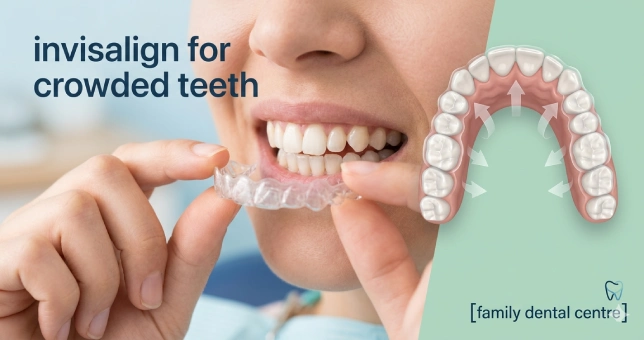
The short answer is: Yes, and with high efficiency. The invisalign crowding system relies on a series of custom-made clear trays that apply gentle, precise pressure to specific teeth at specific times. Using advanced 3D digital planning (iTero), orthodontists in Muscat can map out the exact path for every tooth, making Invisalign an ideal choice for those seeking both precision and comfort.
Invisalign for Mild, Moderate, and Severe Crowding (H2)
Treatment protocols vary based on the severity of the crowding (measured in millimeters), which determines the number of trays and the overall timeline:
Mild Crowded Teeth (Less Than 4mm) (H3)
In cases of mild crowding (less than 4mm), treatment is remarkably fast. Often requiring only a few sets of clear aligners, patients in Oman can see their final results in as little as 4 to 6 months.
Moderate Crowded Teeth (4–8mm) (H3)
This is the most frequent type seen in crowding treatment muscat. Moderate crowding (4–8mm) typically requires a treatment plan spanning 12 to 15 months. During this time, Invisalign slightly expands the dental arch or shifts back teeth to create the necessary room for the front teeth to align.
Severe Crowding Invisalign (More Than 8mm) (H3)
It was once believed that severe cases (more than 8mm) could only be treated with metal braces. However, with modern severe crowding invisalign techniques, we can now treat complex cases. This may involve using additional “attachments” or jaw expansion, with timelines usually ranging from 18 to 24 months.
Do You Need Extraction Before Invisalign for Crowded Teeth? (H2)
Many patients worry about the idea of “tooth extraction” when they hear their teeth are crowded. In reality, orthodontists in Oman always aim to preserve your natural teeth whenever possible, utilizing modern techniques to create space without losing a single tooth.
While extraction was once the standard for overcrowded mouths, today’s technology offers more conservative alternatives. Depending on the severity of your case, your doctor might choose one of the following methods:
IPR: The Non-Invasive Alternative (H3)
Thanks to IPR (Interproximal Reduction), space can often be created without extractions. This is a simple, painless process that involves slenderizing the sides of the teeth by fractions of a millimeter. By gently reducing a tiny amount of enamel between teeth, your orthodontist creates just enough room for the teeth to slide into their correct positions.
When Extraction is Necessary (H3)
However, in extreme cases, extraction may still be necessary to ensure long-term stability. If the crowding is so severe that it affects the jaw structure or the health of the surrounding bone, removing a tooth might be the only way to achieve a functional and healthy bite that won’t shift back after treatment.
How Invisalign Attachments Fix Crowded Teeth (H2)
To achieve these precise movements—whether space was created through IPR or extraction—the aligners often need a little extra help. This is where specialized dental components come into play to ensure every tooth reaches its destination.
These components turn a simple plastic tray into a powerful orthodontic tool. Here is how they work to solve the puzzle of crowding:
The Role of Tiny Resin Dots (H3)
Attachments are the “unsung heroes” of the Invisalign journey. These are tiny, tooth-colored resin dots bonded to specific teeth during your treatment. Because they are customized to match your tooth color, they remain discreet while providing a huge functional advantage.
Achieving Complex Tooth Rotations (H3)
They act as anchor points, allowing the aligners to “grip” the tooth and move it in complex directions that the tray alone couldn’t achieve. This is especially vital for crowded teeth that are severely rotated or tilted. The attachment gives the aligner the necessary leverage to “twist” the tooth into alignment, making the treatment of crowding highly effective and predictable.
Risks of Untreated Crowded Teeth (H2)
Ignoring crowded teeth is not just a cosmetic issue; it leads to several health risks, including:
Cleaning Difficulties: Overlapping teeth create tight angles that toothbrushes can’t reach, leading to plaque buildup.
Gum Disease: Constant bacterial accumulation causes gingivitis and gum recession.
Uneven Tooth Wear: Poor alignment puts excessive pressure on certain teeth, leading to premature chipping or fractures.

Invisalign for Crowded Teeth Before and After (H2)
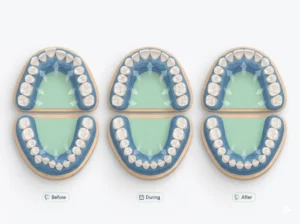
The results of Invisalign for crowding are often transformative. Before treatment, patients typically present with overlapping smiles and biting difficulties. After committing to the treatment plan and wearing the trays for 22 hours a day, patients achieve a perfectly symmetrical dental arch. Success stories in our Muscat clinics prove that compliance is the secret to a perfect, lasting smile.
Conclusion:
If you suffer from dental crowding and want a solution that combines efficiency with a discreet appearance, clear aligners crowded teeth oman are your best bet. Start your journey today with a specialized consultation to map out your new smile.
FAQ
Can Invisalign fix severe crowded teeth?
Yes, modern Invisalign technology is now highly capable of correcting severe crowding that was once thought to require traditional braces. By using advanced software to plan precise movements and employing Invisalign attachments—small, tooth-colored bumps bonded to the teeth—orthodontists can gain the leverage needed to rotate and shift even the most stubborn teeth into their proper positions. While severe cases are more complex, the combination of specialized attachments and “smart” aligner material makes it a very effective solution for extreme crowding.
Do I need tooth extraction before Invisalign for crowded teeth?
Not necessarily. Orthodontists today prioritize preserving your natural teeth whenever possible. Many patients can avoid extractions through a process called IPR (Interproximal Reduction), where tiny amounts of enamel are slenderized between teeth to create the necessary space. However, in cases where the jaw is exceptionally small or the crowding is so intense that it threatens the stability of the bone and gums, a strategic extraction might still be recommended to ensure the healthiest and most stable long-term result.
How long does Invisalign take for crowded teeth?
The timeline for treating crowded teeth varies based on how much movement is required, but typically falls between 12 to 18 months.
Mild crowding might be resolved in as little as 6 months.
Moderate cases usually take about a year.
Severe crowding can extend to 24 months or more.
The most significant factor in your timeline is “compliance”—wearing your aligners for the recommended 22 hours a day is the fastest way to reach your finish line.