

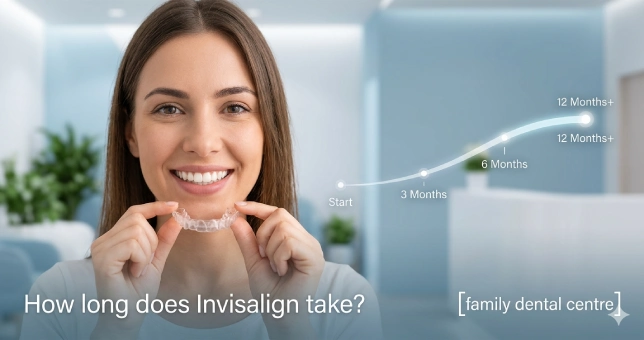
For many people in Oman, the dream of having a perfectly aligned smile is often held back by one simple question: “How long will I have to wear those trays?” Whether you are a professional working in the ministries of Muscat or a student at Sultan Qaboos University, time is your most valuable asset.
Invisalign has revolutionized orthodontics in the Sultanate, offering a discreet alternative to traditional “train-track” braces. But unlike metal braces, where the orthodontist is in total control, the invisalign treatment duration in Oman depends heavily on a partnership between the latest 3D technology and your personal commitment.
In this guide, we will break down the realistic timeline you can expect when starting your journey toward a world-class smile in Oman.
Average Invisalign Treatment Time
If you are looking for a quick answer, the average invisalign time in Muscat typically ranges between 12 to 18 months. However, it is important to understand that “average” is just a baseline. Because every smile in Oman is unique, some patients may finish their journey in as little as 6 months, while others with more significant alignment needs might require two years.
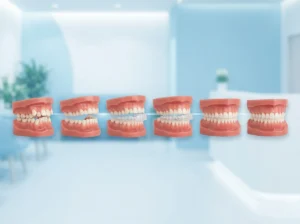
Unlike traditional methods, Invisalign uses Invisalign stages—a series of digital steps mapped out by specialized software. Each stage represents a tiny, calculated movement of your teeth. The number of invisalign trays you receive is the most accurate indicator of your personal timeline.
Invisalign Timeline by Case Type
The complexity of your dental “starting point” is the biggest factor in determining your finish line. Most clinics in Oman categorize cases into three main types:
Mild Cases (4–6 Months)
These are often referred to as “Express” cases. If you have very minor crowding or a small gap (diastema) that has bothered you for years, you might only need 10 to 12 sets of trays. Many patients in Oman choose this option before major life events, such as weddings or graduations.
Moderate Cases (12–15 Months)
This is the most common category for adults in Oman. It involves correcting moderate crowding, minor bite issues, or teeth that have shifted after previous orthodontic treatment. You can expect a steady progression that noticeably transforms your smile by the one-year mark.
Complex Cases (18–24 Months)
For severe overcrowding, significant rotations, or complex malocclusions (bite issues), the journey is longer. In these instances, your orthodontist might use “attachments”—small, tooth-colored bumps—to give the trays extra leverage to move the teeth.
Month-by-Month Invisalign Progress
What does the journey actually feel like? Here is what most Omani patients experience:
Month 1: The “Adjustment Phase.” You’ll get used to the feeling of the trays and the routine of removing them before eating Omani Halwa or drinking coffee.
Months 3-5: Visual changes begin. This is the “Motivation Phase” where you start seeing the gaps close or the crowding ease in the mirror.
Months 6-12: The “Refinement Phase.” Your bite begins to feel more aligned, and your jaw position starts to settle into its new, healthy home.
Final Months: The “Polishing Phase.” Your orthodontist makes micro-adjustments to ensure the aesthetics are perfect.
What Affects Invisalign Treatment Time?
Understanding the variables that influence your journey is essential for setting realistic expectations. Here are the three primary pillars that dictate the speed of your transformation:
Biological Factors and Bone Density
Every patient in Oman has a unique biological makeup. Your teeth are not just moving through space; they are moving through living bone tissue. Factors such as your age, genetics, and jawbone density play a significant role. Some individuals have “high bone remodeling rates,” allowing their teeth to shift more fluidly, while others may have denser bone structure that requires a more gradual pace to ensure the roots remain healthy and stable.
Patient Compliance: The 22-Hour Rule
This is the most critical factor under your control. Unlike fixed braces, Invisalign is removable, which is both a blessing and a responsibility. To stay on track with your average invisalign time in Muscat, you must wear your aligners for at least 20 to 22 hours every day. Every hour the trays are out of your mouth, your teeth begin to settle back into their old positions. Frequent “cheating” or forgetting to put your trays back in after meals can lead to “tracking errors,” which inevitably adds weeks or even months of corrective stages to your plan.
The Complexity of Dental Realignment
Not all tooth movements are created equal. Closing a small gap or fixing minor crowding is a relatively straightforward mechanical task. However, complex movements—such as rotating a canine tooth or correcting a severe overbite—require more time and specialized invisalign stages. If your case involves significant structural changes, your orthodontist will prioritize safety and precision over speed to ensure that your bite is not only beautiful but also functional and long-lasting.
How to Speed Up Invisalign Treatment
While you can’t fight biology, you can optimize your results. To keep your invisalign treatment duration in Oman as short as possible, follow these professional tips:
Stick to the 22-Hour Rule: Only take them out to eat and brush.
Use “Chewies”: These small silicone cylinders help seat the trays perfectly against your teeth, ensuring the force is applied exactly where it’s needed.
Don’t Skip Appointments: Even though Invisalign requires fewer visits than braces, your check-ups in Muscat are vital to ensure you are “tracking” correctly.
Maintain Oral Hygiene: Cavities or gum inflammation can force your dentist to pause orthodontic treatment to fix the underlying health issue.
Invisalign vs Braces: Treatment Time Comparison
Many patients ask: “Is Invisalign faster than braces?”In many cases, yes. Because Invisalign applies force to the entire surface of the tooth rather than just a single point (the bracket), it can sometimes move teeth more efficiently. However, for extremely complex structural jaw changes, traditional braces might still be the faster, more powerful tool.
| Feature | Invisalign | Traditional Braces |
| Simple Cases | 4–9 Months | 12–18 Months |
| Average Cases | 12–15 Months | 18–24 Months |
| Complex Cases | 18–24 Months | 24–36 Months |
Retention Phase After Invisalign
The day you finish your last tray is a cause for celebration, but the journey doesn’t end there. The Retention Phase is critical. Once your teeth are in their perfect position, the bone around them needs time to harden and “lock” them in place.
In Oman, most orthodontists recommend a “Vivera” retainer or a fixed wire behind the teeth. Initially, you will wear your retainer full-time, eventually transitioning to night-wear only. Skipping this phase is the fastest way to lose the smile you spent months building.
Conclusion
So, how long does Invisalign take? For the majority of patients in Oman, you are looking at a 12 to 15-month commitment to achieve a lifetime of confidence.
The beauty of the Invisalign system is its predictability. Thanks to the digital planning used in clinics across Muscat, you will know almost exactly how many trays you need before you even start. If you are ready to stop wondering and start seeing results, the first step is a consultation to see your personalized 3D smile map.
Your future smile is already designed—it’s just a few trays away!
FAQ
How Long Does Invisalign Take?
The journey to a perfect smile typically spans between 12 to 18 months for most adults. However, because Invisalign is built on a high-precision digital map of your teeth, the exact duration depends on the total number of invisalign trays in your specific plan. Minor adjustments can conclude in a few months, while complex structural changes may take up to two years.
Can Invisalign treatment finish in 6 months?
Yes, it is possible for “Express” or mild cases. If you only require minor closing of small gaps or correcting very slight crowding, your average invisalign time in Muscat could indeed be as short as 6 months. This “fast-track” option is common for patients who had braces in the past and are looking to correct minor shifting.
What happens if I don’t wear aligners 22 hours a day?
Consistency is the engine that drives your progress. If you fall short of the 22-hour rule, your teeth will begin to “lag” behind the digital plan. This doesn’t just slow down the process; it can cause your current trays to stop fitting correctly (known as “off-tracking”), which may require your dentist to order new sets of trays and significantly increase your invisalign treatment duration in Oman.