
Dental implants have revolutionized restorative dentistry, offering a level of stability and aesthetics unmatched by traditional dentures and bridges. For many residents of Muscat, Salalah, and across Oman, getting a “new tooth” is exciting, but the technical nature of the procedure can sometimes cause anxiety.
What Is a Dental Implant and Why Understanding Its Parts Matters
Before we break down the parts, it is important to understand why this knowledge is valuable for you as a patient in the Omani market. Knowing the anatomy of your implant ensures you are getting the best medical value.
Informed Decision Making: Not all implants are created equal. Different brands and materials have different success rates.
Cost Transparency: When you receive a quote for dental implants in Oman, you aren’t just paying for a “tooth.” You are paying for a high-tech root, a precision-engineered connector, and a custom-crafted crown.
Maintenance and Longevity: Knowing how the parts fit together helps you understand how to clean them and what symptoms (like a loose screw) require a visit to the dentist.
The 3 Main Parts of a Dental Implant
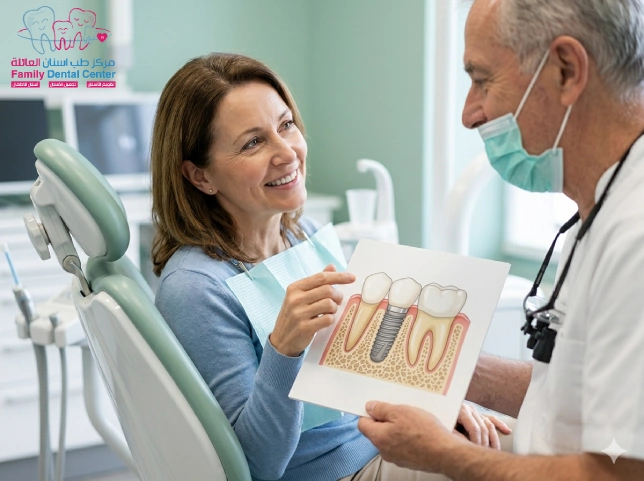
A successful dental restoration relies on three primary pillars: the Fixture, the Abutment, and the Crown. Each serves a distinct biological and mechanical purpose.
1. Implant Fixture (The Root/Post)
The fixture is the “foundation” of the entire system. It is a small, screw-like post that is surgically inserted into the jawbone.
Design and Threads: Most fixtures feature a threaded design (like a screw) to increase the surface area in contact with the bone. This provides “primary stability” immediately after surgery.
The Magic of Osseointegration: This is the biological process where your bone cells actually grow into and attach to the surface of the implant. This process is why implants feel like natural teeth—they literally become part of your body.
Material Selection: In Oman, the vast majority of fixtures are made from Grade 4 or 5 Medical Titanium. It is favored because it is “biocompatible,” meaning the human body does not recognize it as a foreign object.
2. Abutment (The Connector)
If the fixture is the root and the crown is the tooth, the abutment is the “bridge” that connects them. It is a small attachment that sits at or just above the gum line.
The Connection Mechanism: The abutment is usually screwed into the internal chamber of the fixture. This requires extreme precision; if the fit isn’t perfect, bacteria can seep into the gap.
Custom vs. Prefabricated: At premium clinics like Family Dental Centre, you may have the choice between a standard abutment or a “custom abutment” designed specifically for your unique gum shape.
3. Crown (The Visible Restoration)
The crown is the only part of the dental implant that you and others will see. It is the functional part that allows you to chew and the aesthetic part that completes your smile.
The Art of Shade Matching: Your dentist will use a shade guide to match the crown to your natural teeth, considering the unique lighting conditions in Oman to ensure the tooth looks natural in sunlight.
Functional Durability: The crown must be strong enough to withstand the forces of chewing—which can exceed 200 pounds of pressure on the molars.
Materials Used in Dental Implant Parts: Pros and Cons
One of the most frequent questions patients in Oman ask is about the materials used. The choice of material affects both the look and the lifespan of the implant.
Titanium for Fixtures and Abutments
Titanium has been used in dental and orthopedic surgeries for decades. Its greatest advantage is its durability. It can bend slightly under pressure without breaking, which mimics the natural “give” of a real tooth’s periodontal ligament.
Crown Options: Porcelain, Zirconia, and More
When choosing the visible part of your tooth, you have several options:
Zirconia: Extremely popular in Muscat for its incredible strength and lifelike appearance. It is white, meaning there is no risk of a “grey shadow” appearing at the gum line.
E-max: Ideal for front teeth due to its superior translucency, which mimics natural enamel perfectly.
How Dental Implant Parts Are Placed: Step-by-Step Procedure
The journey to a new smile at Family Dental Centre typically follows a precise biological timeline to ensure the highest success rate.
Phase 1: Diagnostic Planning: Using 3D CBCT scans, the dentist maps out exactly where the Fixture will go.
Phase 2: Surgical Placement: The Fixture is placed. Usually, a Cover Screw is used to seal the top of the fixture while it heals.
Phase 3: Osseointegration: You wait several months (usually 3-6) for the bone to fuse with the titanium fixture.
Phase 4: Abutment Attachment: The dentist removes the cover screw and attaches the Permanent Abutment.
Phase 5: Crown Placement: The final custom-made crown is secured, completing your restoration.
Additional Components: Healing Abutments, Screws, and More
Beyond the “Big Three,” other small parts play a huge role during the healing phases of your treatment.
Healing Abutments (Healing Caps): These are taller than cover screws and stick out through the gum. They “train” the gum tissue to heal in a circular shape so the final crown looks natural.
Cover Screws: These protect the internal threads of the fixture during the initial healing phase, preventing bone or tissue from growing inside the screw hole.
Analog and Transfer Pins: These are parts used by the dental laboratory to create an exact replica of your mouth.
Dental Implants in Oman: Local Considerations and Costs
When seeking treatment in the Sultanate, there are specific local factors to consider that impact the choice of parts.
Omani Cuisine: Traditional foods like Shuwa require a high-quality Zirconia Crown that can handle fibrous textures without chipping.
International Standards: Ensure the parts used are internationally certified (FDA or CE approved). High-quality brands invest millions in research to ensure their fixture surfaces encourage bone growth.
Expertise in Muscat: Choosing a professional clinic like Family Dental Centre ensures you are getting digital dentistry (CAD/CAM) accuracy for every component.
Caring for Your Dental Implant Parts Long-Term
Implants can last a lifetime, but they require diligent maintenance to prevent infections.
Daily Hygiene: Brush and floss just like natural teeth, paying extra attention to the gum line around the Abutment.
Regular Checkups: Visit your dentist in Oman every 6 months to ensure the screws remain tight and the bone remains healthy.
Avoid Hard Objects: Do not use your implant to open bottles or bite on ice, as this could chip the porcelain crown.
Conclusion: Your Path to a Perfect Smile
Choosing to get a dental implant is a significant decision. By understanding that your new tooth is a high-tech combination of a Titanium Fixture, a Precision Abutment, and a Custom Crown, you can appreciate the value of professional dental care.
In the Sultanate of Oman, Family Dental Centre stands as a beacon of quality, ensuring that every component of your implant is sourced from the world’s leading manufacturers. Don’t settle for less when it comes to the foundation of your smile—ensure every part of your dental implant is built to last.
FAQS
What are the main parts of a dental implant?
A dental implant consists of three parts: the Fixture (the root), the Abutment (the connector), and the Crown (the visible tooth).
What material is used for dental implant fixtures?
Most fixtures are made of Medical-grade Titanium because of its unique ability to fuse with human bone, though Zirconia fixtures are an alternative for those with metal allergies.
How does the abutment connect the implant to the crown?
The abutment is screwed into the fixture, and then the crown is either cemented or screwed onto the abutment, ensuring a stable and secure fit.